Employee self-service usually fails because it launches after the main HR system, employees can still email HR instead, the first login is hard, the app is built for office staff, and managers don't approve requests in it. Fix it by launching with the core system, moving three common tasks into the app with a cut-off date, and publishing adoption by department every month.
- Adoption is the whole business case, because the efficiency case rests on work moving from HR to the people who own the information.
- The strongest predictor of adoption is timing: launching with the core system dramatically outperforms launching months later.
- Pick three high-frequency transactions and make the app the only route, with a stated cut-off date.
- Pre-provision every account and distribute access by SMS or WhatsApp, not corporate email, since much of a GCC workforce is not desk-based.
- Publishing adoption by department monthly moves the number more than any central communication campaign.
Self-service is the feature that most often gets bought and least often gets used. An organisation licenses an HRMS, the app is configured and branded, an announcement goes out, and three months later the HR team is still receiving leave requests by email and printing salary certificates on request. In many organisations, only a small share of employees log in regularly, and the platform is quietly judged to have underdelivered.
The platform is usually not the problem. Adoption failure follows a predictable pattern, and each stage of it is addressable, but the fixes are behavioural and operational rather than technical.
Why employee self-service adoption matters
It is worth being blunt about why this matters. The efficiency case for an HRMS rests almost entirely on work moving from the HR team to the people who own the information. If employees do not update their own details, request their own leave, download their own payslips, and upload their own documents, then the HR team is still doing all of that, plus maintaining a system.
That is the scenario where an HRMS increases workload rather than reducing it, and it is more common than vendors admit. The query volume we discussed in the real cost of payroll errors does not fall because a system exists. It falls when employees can answer their own questions.
Reason 1: Self-service launched after the main HR system
The single strongest predictor of adoption is when self-service was introduced. Rollouts where employee access goes live in the same week as the system of record consistently outperform those where it follows two or three months later.
The mechanism is habit. At go-live, everyone knows something is changing and is willing to be told how things work now. Three months later, habits have re-formed around the new normal, which is usually still emailing HR, and you are asking people to change twice. Sequence self-service into the implementation plan rather than treating it as phase two.
Reason 2: Employees can still email HR instead
If HR continues to accept leave requests by email, email remains the path of least resistance. Adoption requires the self-service channel to be the only channel for a small number of high-frequency transactions.
AmalOps leave management lets employees request leave and see balances on their phone.
Leave rules differ by country; see our GCC leave law comparison.
The transition needs care and a clear cut-off date, and it works best when the change is framed around employee benefit rather than HR convenience: requests are tracked, approvals are visible, and nothing gets lost in an inbox. But the substance is straightforward. Choose three transactions, announce that they move to the app on a specific date, and then hold the line. Leave requests, payslip access, and personal document updates are the usual three.
Reason 3: The first login is harder than the task
Watch a new user attempt first login on a shared site and the failure points become obvious. They cannot find the app, they are not sure which credentials to use, the password rules are unfamiliar, or the sign-in page renders in a language they do not read comfortably.
Every one of these is fixable, and the fixes are unglamorous. Pre-provision accounts rather than asking people to register. Push the app link by SMS or WhatsApp rather than email, because a warehouse supervisor is more likely to open a text than a corporate email. Support Arabic and the other languages your workforce actually uses, and let the user pick at first launch rather than inheriting a default. Where you have populations without smartphones, provide a kiosk at the site.
Reason 4: The app was built for office staff, not site teams
Most self-service interfaces are designed by and for desk-based staff. In a typical GCC organisation, a substantial part of the workforce is not desk-based: site teams, drivers, hospitality staff, retail, facilities. Their needs differ, and so does their tolerance for friction.
For these populations, three design decisions dominate adoption. The app has to work on older devices and intermittent connectivity. The primary actions have to be reachable in one tap from launch, not buried in a menu. And clock-in, if you use it, has to be faster than the alternative, or the alternative wins.
See how mobile attendance works for site teams.
Reason 5: Managers don’t approve requests in the app
Employee adoption depends on manager adoption, and this is consistently underestimated. If a line manager does not approve leave in the system, the employee's request sits pending, the employee concludes the app does not work, and they revert to asking their manager directly. One unresponsive manager can suppress adoption for an entire department.
Managers need a different pitch from employees. They do not care about self-service. They care about not being the bottleneck, seeing who is off next week before approving a request, and not having to remember whose probation review is due. Show them those three things and approval behaviour follows.
| Why self-service fails | The fix |
|---|---|
| Launched months after the main HR system | Go live with self-service in the same week as the core system |
| Employees can still email HR instead | Pick three tasks (leave, payslips, document updates) and set a cut-off date after which they are app-only |
| The first login is harder than the task | Create accounts in advance and send login links by SMS or WhatsApp, in Arabic and other languages |
| Built for office staff | Make it work on older phones and weak connections, with key actions one tap from opening |
| Managers don't approve in the app | Train managers separately and show them what's in it for them: no bottlenecks, team absences in one view |
How to increase employee self-service adoption: 7 steps
Across implementations, the interventions with the clearest effect are these:
- Launch self-service with the core system, never after it
- Pick three transactions and make the app the only route, with a stated cut-off date
- Pre-provision every account; never ask an employee to self-register
- Distribute the link by SMS or WhatsApp, not corporate email
- Train employees in fifteen minutes, in their own language, with the app open
- Train managers separately, on approvals and team visibility rather than features
- Publish adoption by department monthly, so managers can see their own number
The last one is quietly the most effective. Departmental adoption rates, shared without commentary, produce movement that no amount of central communication achieves, because managers do not like being last on a list their peers can see.
How to measure self-service adoption
Login rate is a weak metric. It tells you people opened the app, not that work moved. Three better measures: the proportion of leave requests submitted in-system rather than by email, the proportion of payslips accessed rather than requested, and the monthly volume of HR queries that self-service should have answered.
| Weak measure | Better measure |
|---|---|
| Login rate (only shows the app was opened) | Share of leave requests made in the app |
| App downloads | Share of payslips viewed in the app instead of requested from HR |
| Training attendance | Monthly number of routine HR queries (should fall) |
That third measure is the one to put in front of leadership, because it converts directly into hours. In well-run rollouts, routine HR queries drop noticeably within the first two quarters, and that reduction is what funds the HR team's shift toward work that requires judgement.
How AI assistants make self-service easier
The most common self-service failure is subtler than any of the above: the employee opens the app, cannot find what they need, and emails HR anyway. Navigation defeats them, not motivation.
A conversational layer removes that failure mode entirely. Rather than locating the leave balance screen, an employee asks how many days they have left and gets an answer, in English or Arabic. Rather than searching for a policy document, they ask whether the policy covers their situation. This is the practical, unglamorous application of AI in an HR platform, and it does more for adoption than any interface redesign, because it works regardless of how well the user understands the system's structure.
The AmalOps AI Suite answers leave and policy questions in English and Arabic.
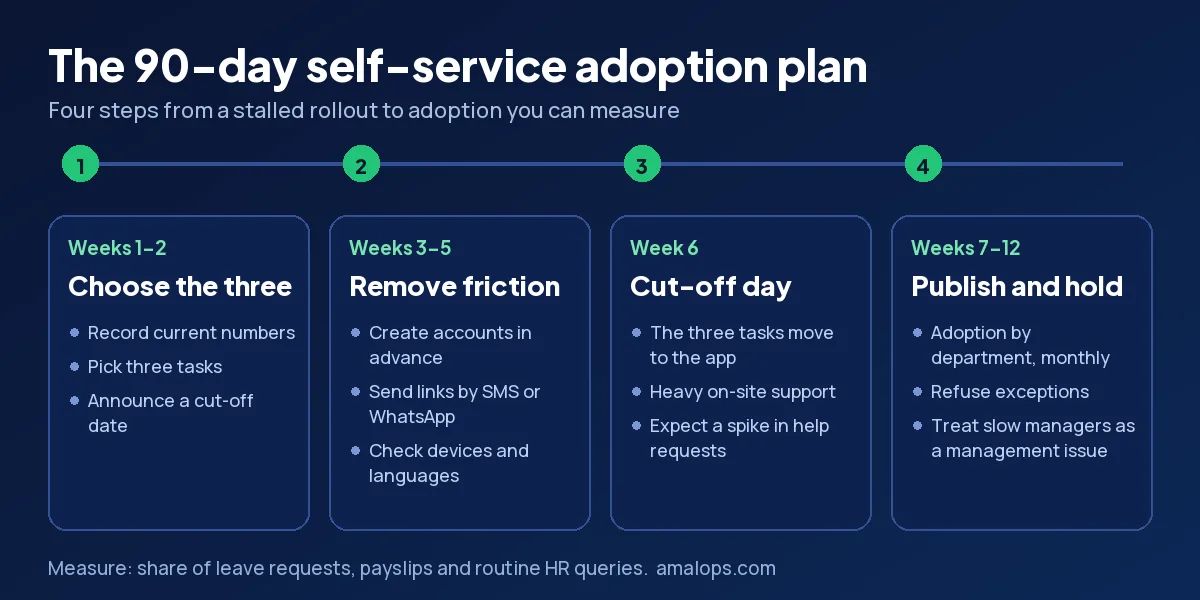
A 90-day self-service adoption plan
If adoption has already stalled, the recovery plan that works is short and specific rather than a communications campaign. Ninety days is enough.
| When | What to do |
|---|---|
| Weeks 1–2 | Record current numbers, choose three tasks, announce a cut-off date at least three weeks away |
| Weeks 3–5 | Remove friction: create accounts, send links, check devices and languages |
| Week 6 | Cut-off date. Heavy on-site support; expect a spike in help requests |
| Weeks 7–12 | Publish adoption by department monthly, refuse exceptions, treat slow managers as a management issue |
What if some employees can’t use self-service?
It is worth being honest that a minority of populations cannot be served by an app, and pretending otherwise damages credibility. Employees without smartphones, workers in accommodation without reliable connectivity, and those with low digital literacy need an alternative that is designed rather than improvised.
The alternatives that work are a kiosk at the site with assisted access, a designated administrative contact for that population, or scheduled sessions where requests are entered on the employee's behalf into the same system. The principle to protect is that the system remains the record even where the employee is not the one typing. What must be avoided is a parallel paper process, because that reintroduces the reconciliation problem the platform was bought to eliminate.
If your self-service adoption has stalled and you want a view on why, talk to us. The cause is usually identifiable in a single conversation about how your workforce is actually structured.